Saturday, October 31, 2009

Scientific Communication

I attended a day long workshop today with Cornelia Dean (science writer for the NYTimes). She has recently written a book called "Am I Making Myself Clear?". It is a guide for scientists about communicating with non-scientists. The book is an easy read and definitely kept my attention. The workshop was definitely a productive way to spend a Saturday!

It was really interesting to hear a group of 12 PhD students struggle to explain to a "normal person" what they study in one minute without using jargon. I actually consider myself pretty good at talking to non-scientists (I did teach middle school for three years after all), and I struggled to come up with a coherent message. The idea that this is something we should think about before hand and have ready had not occurred to me.

It is interesting to think about how universities typically do not encourage or reward scientists who make an effort to communicate with the public or participate in policy discussions. In fact scientists who do make this a priority are often looked down upon by their peers. I suppose this is because that type of communication is not advancing their research, and therefore represents time not spent on that research. It would seem to me that this represents a somewhat flawed values system within the scientific community. I agree that our priority needs to be research, but I think that for the good of the world communication of that research (other than in peer reviewed journals) to the general public needs to be a priority as well. I think this is especially true for scientists funded by taxpayer dollars. Our discoveries belong in the public domain, and the idea that they somehow trickle out of our scientific publications and into the "real world" is inaccurate. This workshop made me realize that it isn't the job of the media to do this communication for us.

When I think about some of the scientists I most admire (Ed Wilson, Jane Goodall, Rachel Carson being the first few who came to mind) I think less about their discoveries and focus more on the books they wrote for general audiences, as well as the activism they dedicate(d) themselves to. I think I admire them in large part because they are/were truly gifted communicators and their writings possess the ability to make people care. As I move forward in my research I look forward to finding ways to share my stories. I hope I have stories to share! Stay tuned...

Tuesday, October 27, 2009

describing myself

I had to write a blurb about myself today for our lab's website. It was challenging because I haven't started doing my own research yet, and I am not totally sure what I want to focus on, although I am beginning to develop some ideas. It ended up being pretty vague and not as technical as I would like, but I think this is as good as I can do for now...

I am interested in deep-sea microbial ecology, specifically in extreme environments (ie hydrothermal vents). I am working to constrain rates of microbially mediated metabolic processes that occur in vent chimney walls through the use of flow-through bioreactors in the lab. I hope to be able to extend these experiments into the field. I am interested in how these types of reactions may influence broader marine biogeochemical cycles. I am particularly interested in the role that vent ecosystems may play in the carbon cycle. I am also interested in the insights that high-temperature microbial life can bring to the search for life elsewhere in our solar system. I come from a geology/environmental science background, and I am fascinated by environmental overlap of geology and biology. It is my long term goal to increase our understanding of how biological and geological process interact in the deep sea.

Monday, October 19, 2009

Fall colors, and other things New England


I spent a day this weekend in the woods of north-central Massachusetts. It was cold and crisp... perfect end of fall weather. I looked for bugs and found very few. I flipped over rocks in a small (freezing!) stream and didn't find any, and was equally unsuccessful under bark of a rotting log, and digging in the soil. I suppose it is to cold for them, but I am curious where they go to. I was reminded that fall is my favorite time in New England, and that (even though it is currently snowing... in mid-October) I am thrilled to be back living in the land of the wonderful Fall.

I learned something about Fall colors this weekend too. The yellow and orange pigments seen in leaves are there all the time, but are normally obscured by the dominant chlorophyll pigments. The gorgeous red, however, are a different story. The red pigments (phycocyanins, if I remember correctly) are made by the plant as it begins to dismantle its chlorophyll and retrieve valuable Nitrogen from the leaves before they fall off. You tend to see red pigments on the top and outermost leaves, and this is because it is triggered by light (so it doesn't occur as much in the shade). This red pigment (the supermodel of all New England fall foliage photo shoots) acts as an umbrella for the leaf cells that are doing the equivalent of removing parts from a power plant without being able to turn off the power source.

I also learned how to stitch photos together and create panoramic images. Here is one that is the opposite of a panorama, but I am not sure what you call that!


Saturday, October 10, 2009

lessons learned about teaching

In my daily classes and lectures I have been learning a huge amount, but not just about the scientific content being discussed. I frequently find myself thinking about whether the lecturer's style and presentation are effective, and what specific things I can hold on to to make my future talks better. I have started keeping a seminar notebook that I bring to all the out-of-class talks that I go to, and more often that not I write down hints about how to make powerpoint presentations engaging (for example start out by giving the audience a puzzle and offer a prize at the end for someone who figures it out), or things to avoid (for example, giving your presentation to the board and not noticing a question in the audience because your back is turned). I have even come up with a set of symbols for these notes so that I can flip through and immediately find all of the powerpoint hints, or all of the references I meant to look up, or all of the ideas about my own research that have come out of these talks. Yes, I am an organizational nerd for doing this, but I don't care! Flipping through my notebook and seeing the symbols I have created for myself makes me feel on top of things... and I'll take that in whatever small ways I can.

I have also been thinking about teaching methodology. This week I had a take home exam, and I can't decide whether I want to avoid giving this type of assignment because the professor created an absurdly frustrating test that was so open-ended that it sucked up as much time as you were willing to give to it (I spend about 15 hours before giving up), or if I think the professor actually created a really valuable assignment because it was a learning experience in itself rather than simply being an exercise in regurgitating details provided to us during lecture.

In one class this week we had a guest teacher who did a great job mixing powerpoint slides with posing questions to his audience, and writing things on the board. I have typically either done a powerpoint lecture, or done an interactive activity, but seeing this professor do both was very cool. The powerpoint had images and figures that would have been too difficult to draw on the board, but it also kept the professor from going too far off track. Simultaneously he was asking us questions (how would you test for X in this case?) and using the answers pulled from the group to guide the outline of notes he was writing on the board. While I was totally bored by the topic (experiments testing genetic controls on bacterial cell division) I was very engaged in trying to pick apart his methods. Hopefully I will be able to emulate them in the future! Unfortunately this was a class and not a seminar, so I was not taking notes in my seminar notebook... I guess this exposes a flaw in my elegant organizational system. :(

The idea of teaching students to think critically and providing them with the tools to teach themselves rather than teaching them facts is one that seems like an enlightened strategy in theory, but in practice I think is very difficult to pull off. Any thoughts on this from all you educators out there?

Saturday, October 3, 2009

The Road Not Taken

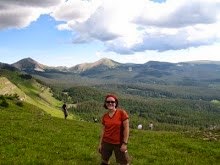
2 of my students scout for tent sites in the Wind River Mountains, Wyoming. June, 2007


Being relatively new to blogging, I am taking my first stab and writing for a Blog Carnival. Here goes...


The Road Not Taken


While I am fairly, ok very, early on in my “career” (having just started graduate school) the idea of alternate paths is one that I have mulled over quite a lot in the last year. I often feel torn between science and wilderness. While these are obviously not mutually exclusive, and often (wonderfully) go hand in hand, for me science had meant less wilderness. Specifically, it has meant no more teaching in the wilderness... at least not for a while. I used to lead backpacking trips for students of various ages, and the idea of being a hands on experiential educator is one that I toyed around with for a long time. When I was a classroom teacher I was very involved with our school’s wilderness program, and had I continued down that path I might have had the opportunity to craft new ways for young men of Dallas to connect with the natural world. I think this is incredibly important given our increasing disconnect with Nature (PLEASE read "Last Child in the Woods" by Richard Louv) and as the climate and conservation issues become more and more profound.


I remember as a NOLS (National Outdoor Leadership School) leading my group of 10 16-18 year olds down a steep rocky slope in the Wind River Mountains after an arduous 12 day of day of traversing a 3 mile (yes, 3 miles in 12 hours = immense frustration) scree slope full of house-sized boulders. We were rushing to beat a building storm. Our group got into camp and set up tents just in time for us to tell our students to get out of their tents and assume lightning position in the rain and hail (to avoid proximity to metal poles). Then, as hypothermia became a greater risk than the lightening (roughly 30 minutes later) telling our students to get back in the tents. It was a very difficult day physically, and emotionally. Clearly, my memories of wilderness education are not all wonderful, but after spending a month taking care of themselves and each other in the wilderness those students were more confident, more capable, better leaders, and were certainly Wilderness advocates for life. I learned more about myself, and my leadership style working for that organization group than i will in any other job... I’m certain. The flip side is that I was not doing science, and I missed it.


I decided to leave both classroom teaching (middle school life and earth/space science and high school marine science) and wilderness education behind when I applied to graduate school. I loved teaching about science, and especially talking about what scientists that I knew were up to, but I really missed actually doing science. The classroom teaching had allowed me the schedule to do wilderness based experiential education in the summers, but I am fairly certain graduate school will not.


There are things I already miss... now that I am a whopping 2 months in. Primarily I miss my my colleagues and students. I miss coaching, and watching skills and confidence grow outside of the classroom. I miss my former students running into my room to say hi (or possibly trying to disrupt my classes). I miss having a wonderful group of educators around to collaborate or commiserate with. I miss the fun and silliness that comes with middle school. I miss my after school climbing club.


However, I am somewhere that is almost overwhelming in its vibrancy. The almost tangible swirling energy and idea make it an incredibly exciting and energizing place to be. I had missed doing research while I was teaching, and now I am picking projects and taking classes, and learning a huge amount. Getting paid to learn is quite the luxury, and I consider myself very lucky for the opportunity! I don’t know where exactly the PhD route will take me, but I know that I will always be an educator of some sort. In some foggy crystal ball vision I can almost see the path not taken and the chosen route converging down the line a ways where I create a wilderness-based science school in some beautiful location, maybe overlooking the sea on the Maine coast.

Monday, September 21, 2009

fun found file

I found this today while going through old files looking for something. It is clearly out of season, but since I have been missing teaching this week it is appropriate. Just a bit of background... the school where I used to teach had chapel twice a week for the middle school. Teachers were required to be there. This was my least favorite part of the job, but it really wasn't all that bad... usually.

A beautiful moment (winter 07?)

As the chapel doors opened out to the main green after the service today, one of the most wonderful moments of my thus far very short teaching career occurred. There door I was looking through framed the lit Christmas tree, and as the chilly air rushed in, we all saw the first snow flurries swirling around the tree. This was accompanied by the excited gasps of about 250 thrilled young men all in unison while trying to maintain the composure required of chapel. The older ones forgot for a second that they are no longer little boys. I hate to admit it but I almost teared up. Maybe it was because a teacher had just finished talking about his son who passed away 10 years ago. There was just something about the tangible kid energy and the visual expression of innocence and enthusiasm that really was beautiful. A colleague also noticed this, and said that it was a moment you would never experience if you weren’t a teacher, and that you couldn’t really explain it. I guess this was my attempt.

Sunday, September 20, 2009

On missing Texas, and lobsters

This is my parents and I at the beach by their new house in Maine. I promise that the navy blue theme was NOT on purpose.


This weekend I caught up with a few friends I left behind in Texas. Some former co-workers had a get together and they thought enough about me to give me a call! It meant a lot to feel remembered and missed, because I have certainly been missing them. I promised one friend a new blog post this weekend. I was psyched to hear that someone was actually reading my blog down there, but now there is pressure to write something interesting... thanks Nick!

I have started having Sunday night dinners at my parent's house. I have to admit that I really look forward to these evenings. Maybe because I was living far away from "home" for 3 years, or maybe because I have become a poor graduate student, but it is wonderful to be able to go back to the house that has always been home and have dinner with my parents. Tonight we had lobsters that my mom brought back from Maine. Lobster is something that has always been a special treat in my family. I remember learning how to eat lobster the right way when I was very young, and how my older brother used to try to trick me out of the best parts of my lobster. I remember having to "earn" my own lobster by showing my dad that I knew how to eat it without wasting any. At my old summer camp they had a lobster dinner on the last night, and I loved being able to teach people the proper technique. Yes, I can hear some of you now... I just like telling people what to do. I guess that might be part of it, but I also love sharing what I know with others... its a fine line though between that and being bossy. I've been working on walking that line years! Anyhow, now that my parents have this amazing house in Maine, I have somewhere just a few hours away where I can kayak, play around in tide pools (one of my all time favorite activities!), and eat lots of lobster.

More science next time... right now I have some Microbial Physiology reading that has been calling my name all weekend!