Showing posts with label experiential education. Show all posts

Monday, March 8, 2010

Can I be a museum educator when I grow up?

I spent most of Saturday volunteering at the nearby museum of natural history. There was a geology festival and I got to spend the day talking to people about the differences between rocks and minerals, and talking about different types of volcanoes and volcanic rocks. I realized (or maybe remembered) that communicating cool information to other people really is one of my favorite things to do. It occurred to me that museum education would be a pretty ideal job for someone who really loves teaching. You get to plan curricula, spend time one on one with people who are genuinely interested in learning from you, and you get school groups who are excited about being on a field trip. Most importantly you don't have any grading to do, and you don't need to worry about teaching to a standardized test. Now clearly there are some downsides as well, specifically not forming relationships with your students, but from my one day it seems pretty idea. Now, I should stop daydreaming and start studying for that pesky statistics midterm that I have on Wednesday.

Wednesday, January 6, 2010

On class and race issues, and their relevance to my scientific career, or not.

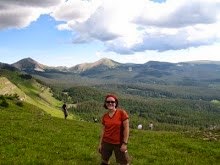
This image provides an appropriate setting for the daydream described below.


Warning: the following post contains ramblings and daydreaming. Please comment if anything needs clarification.

I just finished watching a 4 part PBS/BBC documentary called
America Beyond the Color Line, by Henry Louis Gates Jr. It brought me back to things I haven't thought about as much as I used to since my current graduate program. This film examines the state of black Americans 100 years after W.E.B. DuBois said that the problem of the 20th century would be "the problem of the color line". Gates travels through black America in this film (from Hollywood to wealthy black neighborhoods in Atlanta, to inner city Chicago housing projects and much more) and elegantly communicates a very complicated situation - race relations in America having come incredibly far since the beginning of the Civil Rights movement, but still having far to go. The film identifies a growing gap between inner city disadvantaged African Americans, and the growing African American middle class (and very wealthy) that have "made it". Much of the film asks questions about where to we go from here and how do we bridge this growing gap. There is no easy answer (obviously) and many interconnected approaches ranging from political changes, to localized mentoring and education programs, to a need for bigger dreams and belief that better is possible are all discussed.

So what does this all possibly have to do with me, a white graduate student studying deep sea microbiology? I am not totally sure, but the segments of this film that interviewed educators and high school age students resonated with me, and reminded me why I went into teaching rather than more grad school 3.5 years ago. It is easy to get sucked in to the world of research and academia and never look out. This is understandable given the amount of work and time required of a career as a professor or even life as a grad student.

I have worked with underprivileged students of various ages in a few different mentoring/inspiring/extra help/outdoor experiential ed programs, and it is something I love doing. I sometimes wonder whether I would have a bigger impact doing the science I am doing now (and whatever comes out of that) or through a career of teaching. I am honestly not sure I could hack it as an inner city teacher, and I sometimes feel guilty about that. I do know that I love working with kids, and really enjoy talking to them about how cool science is, and would like this to be part of what I do when I "grow up" (I like to live in a bit of denial-land where I am not yet an adult). I had so many wonderful opportunities growing up that inspired me to study science, and I would love to be able to provide similar experiences for youth who won't get them otherwise.

Back in October I wrote about a workshop I attended about how scientists communicate with The Public. One of the things that got brought up is how outreach-type activities are typically not valued in academia (at least not when it comes to hiring and/or tenure decisions) and that this is a reality that scientists like me (who think it is our responsibility to communicate not just with peer reviewed scholarly papers) have to deal with. Maybe I am cut out for academia and maybe I am not, but here is a day dream of a program that Future Me has started...

Located in the woods somewhere with water (maybe a lake or a river, but ideally a rocky sea shore) on a large tract of pristine land, but within a couple hours drive from a major metropolitan area (read - bad inner city school system) lies a campus that looks part farm, part school, part summer camp, and part laboratory. There is a ropes course, kayaks and/or canoes, camping equipment, cabins, and maybe a big fire ring. There are lab facilities with plenty of salt water tanks and touch tables housing a rotating selection of organisms and a good set of microscopes, and plenty of room to set up experiments. There is a garden that provides local organic produce and maybe even chickens for out kitchen and also provides educational opportunities. This is a property that I (or some very wealthy and dear friend) own and have built up. Hey, its my day dream so maybe I even built some of the buildings.

This campus is home to a variety of programs that have the following goals 1. bring urban youth into the wilderness, 2. get youth excited about science, 3. preach academic excellence, and 4. provide underprivileged kids with role models and connections that last a long time. I can many different types of programs occurring in this facility from a college semester or summer program to weekend or day trips for school groups. The coolest program offered is some type of collaboration with a program in the nearby city that targets a group of youth in elementary school and works with them through their college years on tutoring and mentoring and uses my facility for regular (annual? Monthly?) gatherings or mini-courses… who knows?

There are many programs that do things like this. Someone I know started a program of this type on his own that is particularly impressive. Some day I hope to go visit and learn how he pulled it off. I guess the point is that I am going to eventually want/need to be doing something other than pure science. This film reminded me of things that were definitely a priority at one point in my life that have become more of a passing interests/side project over the last few years.

In some ways it is all about your perspective. Being a geologist taught me to see things in very long time scales, time scales at which global catastrophic climate change might matter, but probably wont change Earth itself all that much. From this perspective, environmental issues are not about saving the planet, but about preserving our ability to live on it, and the environmental issues are the most pressing for humanity to tackle because all the social issues will be irrelevant if we are dead. ON the other hand that type of perspective can allow many of us (ie me) to ignore social issues that just seem too difficult to tackle.

I can’t help comparing two potential contributions that I could make to humanity: one being the creation of a wonderful program that is some fraction of what is described in the day dream above and the other being whatever cool scientific tidbits I might discover along the traditional track lying ahead of me in Academia. Depending on the perspective I look at these options with I can make arguments that either is somehow better. It is hard to know where I would have a greater impact (which is how I like to think of success). I remember as a child having very definitive opinions about just about anything (ask anyone who knew me before I was 18), but much of that certainty has vanished as I have seem a plethora of possible roads to travel (I have written about this before too). Maybe clarity will come, or maybe opportunities will arise, or not, and that will determine where life takes me.

Saturday, October 3, 2009

The Road Not Taken

2 of my students scout for tent sites in the Wind River Mountains, Wyoming. June, 2007


Being relatively new to blogging, I am taking my first stab and writing for a Blog Carnival. Here goes...


The Road Not Taken


While I am fairly, ok very, early on in my “career” (having just started graduate school) the idea of alternate paths is one that I have mulled over quite a lot in the last year. I often feel torn between science and wilderness. While these are obviously not mutually exclusive, and often (wonderfully) go hand in hand, for me science had meant less wilderness. Specifically, it has meant no more teaching in the wilderness... at least not for a while. I used to lead backpacking trips for students of various ages, and the idea of being a hands on experiential educator is one that I toyed around with for a long time. When I was a classroom teacher I was very involved with our school’s wilderness program, and had I continued down that path I might have had the opportunity to craft new ways for young men of Dallas to connect with the natural world. I think this is incredibly important given our increasing disconnect with Nature (PLEASE read "Last Child in the Woods" by Richard Louv) and as the climate and conservation issues become more and more profound.


I remember as a NOLS (National Outdoor Leadership School) leading my group of 10 16-18 year olds down a steep rocky slope in the Wind River Mountains after an arduous 12 day of day of traversing a 3 mile (yes, 3 miles in 12 hours = immense frustration) scree slope full of house-sized boulders. We were rushing to beat a building storm. Our group got into camp and set up tents just in time for us to tell our students to get out of their tents and assume lightning position in the rain and hail (to avoid proximity to metal poles). Then, as hypothermia became a greater risk than the lightening (roughly 30 minutes later) telling our students to get back in the tents. It was a very difficult day physically, and emotionally. Clearly, my memories of wilderness education are not all wonderful, but after spending a month taking care of themselves and each other in the wilderness those students were more confident, more capable, better leaders, and were certainly Wilderness advocates for life. I learned more about myself, and my leadership style working for that organization group than i will in any other job... I’m certain. The flip side is that I was not doing science, and I missed it.


I decided to leave both classroom teaching (middle school life and earth/space science and high school marine science) and wilderness education behind when I applied to graduate school. I loved teaching about science, and especially talking about what scientists that I knew were up to, but I really missed actually doing science. The classroom teaching had allowed me the schedule to do wilderness based experiential education in the summers, but I am fairly certain graduate school will not.


There are things I already miss... now that I am a whopping 2 months in. Primarily I miss my my colleagues and students. I miss coaching, and watching skills and confidence grow outside of the classroom. I miss my former students running into my room to say hi (or possibly trying to disrupt my classes). I miss having a wonderful group of educators around to collaborate or commiserate with. I miss the fun and silliness that comes with middle school. I miss my after school climbing club.


However, I am somewhere that is almost overwhelming in its vibrancy. The almost tangible swirling energy and idea make it an incredibly exciting and energizing place to be. I had missed doing research while I was teaching, and now I am picking projects and taking classes, and learning a huge amount. Getting paid to learn is quite the luxury, and I consider myself very lucky for the opportunity! I don’t know where exactly the PhD route will take me, but I know that I will always be an educator of some sort. In some foggy crystal ball vision I can almost see the path not taken and the chosen route converging down the line a ways where I create a wilderness-based science school in some beautiful location, maybe overlooking the sea on the Maine coast.

Tuesday, August 25, 2009

Reflections on summer adventures as summer comes to a close (part 2)

I spent some time in Maine with my family before moving in to the new place. I was able to meet one nephew for the first time, and reacquaint myself with my other nephew who I have not seen in about 4 years (they live in Kenya). Taking my nephews into the tide pools was a wonderful experience. We found hermit crabs, green crabs, and even a lobster! At first my nephews were not so into getting wet and sandy, and the crabs were a bit scary. After they got more comfortable, however, they loved it! The above photo is one of my nephews not so sure how he feels about a sea star (Asterias forbesi) that my brother found while we were kayaking.

The unfamiliar is scary, and this is why we need to force young people into it. That should be one of the main goals of education. Not to frighten children, but to expose them to as many things as possible so that less is unfamiliar. If we wait too long prejudices are already established and it takes more than a morning walk through tide pools to expand the world and discover something wonderful.

Thursday, July 23, 2009

Sunset disrupts class!


Let me preface this by saying that not only do photos not capture the reality of a beautiful sunset (duh!), but the colors in this image seem dull and muted compared to how they look in my iPhoto.
Anyhow, one of the most amazing sunsets I have ever seen occurred last night. Most evenings here have been cloudy, so last night's show was a real treat. We (the class I am TAing) were in the middle of reviewing for a test when I opened the door for some air. Folks caught a bit of the sherbet colors in the sky and immediately rushed outside. That is the kind of school I like, where gifts from nature need to be appreciated even if there is studying to be done.

I was especially struck by how the circular patterns in the water mirrored those in the clouds. After talking with the class about ocean circulation in the Gulf of Maine and getting a fresh mental picture of the basin somewhat enclosed by George's Bank and the cold northern water funneling in through only a few places, the gyres drawn on the blackboard just inside seemed a wonderful echo to the micro-circulation patterns we were seeing right off our island.