Showing posts with label education. Show all posts

Monday, March 8, 2010

Can I be a museum educator when I grow up?

I spent most of Saturday volunteering at the nearby museum of natural history. There was a geology festival and I got to spend the day talking to people about the differences between rocks and minerals, and talking about different types of volcanoes and volcanic rocks. I realized (or maybe remembered) that communicating cool information to other people really is one of my favorite things to do. It occurred to me that museum education would be a pretty ideal job for someone who really loves teaching. You get to plan curricula, spend time one on one with people who are genuinely interested in learning from you, and you get school groups who are excited about being on a field trip. Most importantly you don't have any grading to do, and you don't need to worry about teaching to a standardized test. Now clearly there are some downsides as well, specifically not forming relationships with your students, but from my one day it seems pretty idea. Now, I should stop daydreaming and start studying for that pesky statistics midterm that I have on Wednesday.

Wednesday, January 6, 2010

On class and race issues, and their relevance to my scientific career, or not.

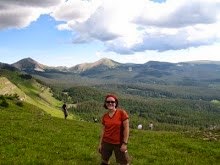
This image provides an appropriate setting for the daydream described below.


Warning: the following post contains ramblings and daydreaming. Please comment if anything needs clarification.

I just finished watching a 4 part PBS/BBC documentary called
America Beyond the Color Line, by Henry Louis Gates Jr. It brought me back to things I haven't thought about as much as I used to since my current graduate program. This film examines the state of black Americans 100 years after W.E.B. DuBois said that the problem of the 20th century would be "the problem of the color line". Gates travels through black America in this film (from Hollywood to wealthy black neighborhoods in Atlanta, to inner city Chicago housing projects and much more) and elegantly communicates a very complicated situation - race relations in America having come incredibly far since the beginning of the Civil Rights movement, but still having far to go. The film identifies a growing gap between inner city disadvantaged African Americans, and the growing African American middle class (and very wealthy) that have "made it". Much of the film asks questions about where to we go from here and how do we bridge this growing gap. There is no easy answer (obviously) and many interconnected approaches ranging from political changes, to localized mentoring and education programs, to a need for bigger dreams and belief that better is possible are all discussed.

So what does this all possibly have to do with me, a white graduate student studying deep sea microbiology? I am not totally sure, but the segments of this film that interviewed educators and high school age students resonated with me, and reminded me why I went into teaching rather than more grad school 3.5 years ago. It is easy to get sucked in to the world of research and academia and never look out. This is understandable given the amount of work and time required of a career as a professor or even life as a grad student.

I have worked with underprivileged students of various ages in a few different mentoring/inspiring/extra help/outdoor experiential ed programs, and it is something I love doing. I sometimes wonder whether I would have a bigger impact doing the science I am doing now (and whatever comes out of that) or through a career of teaching. I am honestly not sure I could hack it as an inner city teacher, and I sometimes feel guilty about that. I do know that I love working with kids, and really enjoy talking to them about how cool science is, and would like this to be part of what I do when I "grow up" (I like to live in a bit of denial-land where I am not yet an adult). I had so many wonderful opportunities growing up that inspired me to study science, and I would love to be able to provide similar experiences for youth who won't get them otherwise.

Back in October I wrote about a workshop I attended about how scientists communicate with The Public. One of the things that got brought up is how outreach-type activities are typically not valued in academia (at least not when it comes to hiring and/or tenure decisions) and that this is a reality that scientists like me (who think it is our responsibility to communicate not just with peer reviewed scholarly papers) have to deal with. Maybe I am cut out for academia and maybe I am not, but here is a day dream of a program that Future Me has started...

Located in the woods somewhere with water (maybe a lake or a river, but ideally a rocky sea shore) on a large tract of pristine land, but within a couple hours drive from a major metropolitan area (read - bad inner city school system) lies a campus that looks part farm, part school, part summer camp, and part laboratory. There is a ropes course, kayaks and/or canoes, camping equipment, cabins, and maybe a big fire ring. There are lab facilities with plenty of salt water tanks and touch tables housing a rotating selection of organisms and a good set of microscopes, and plenty of room to set up experiments. There is a garden that provides local organic produce and maybe even chickens for out kitchen and also provides educational opportunities. This is a property that I (or some very wealthy and dear friend) own and have built up. Hey, its my day dream so maybe I even built some of the buildings.

This campus is home to a variety of programs that have the following goals 1. bring urban youth into the wilderness, 2. get youth excited about science, 3. preach academic excellence, and 4. provide underprivileged kids with role models and connections that last a long time. I can many different types of programs occurring in this facility from a college semester or summer program to weekend or day trips for school groups. The coolest program offered is some type of collaboration with a program in the nearby city that targets a group of youth in elementary school and works with them through their college years on tutoring and mentoring and uses my facility for regular (annual? Monthly?) gatherings or mini-courses… who knows?

There are many programs that do things like this. Someone I know started a program of this type on his own that is particularly impressive. Some day I hope to go visit and learn how he pulled it off. I guess the point is that I am going to eventually want/need to be doing something other than pure science. This film reminded me of things that were definitely a priority at one point in my life that have become more of a passing interests/side project over the last few years.

In some ways it is all about your perspective. Being a geologist taught me to see things in very long time scales, time scales at which global catastrophic climate change might matter, but probably wont change Earth itself all that much. From this perspective, environmental issues are not about saving the planet, but about preserving our ability to live on it, and the environmental issues are the most pressing for humanity to tackle because all the social issues will be irrelevant if we are dead. ON the other hand that type of perspective can allow many of us (ie me) to ignore social issues that just seem too difficult to tackle.

I can’t help comparing two potential contributions that I could make to humanity: one being the creation of a wonderful program that is some fraction of what is described in the day dream above and the other being whatever cool scientific tidbits I might discover along the traditional track lying ahead of me in Academia. Depending on the perspective I look at these options with I can make arguments that either is somehow better. It is hard to know where I would have a greater impact (which is how I like to think of success). I remember as a child having very definitive opinions about just about anything (ask anyone who knew me before I was 18), but much of that certainty has vanished as I have seem a plethora of possible roads to travel (I have written about this before too). Maybe clarity will come, or maybe opportunities will arise, or not, and that will determine where life takes me.

Wednesday, November 18, 2009

A(nother) big 'ol piece of (wicked) humble pie

Today I got the lowest grade that I have ever earned on a test. It made me feel like crap. Because of this, I may or may not get the grade for the course that I need in order for this course to "count". Everyone keeps telling me not to worry, and that it will work out, and that grades don't matter in grad school, but none of that really helps much. I have decided to work my butt off in this last section of the course, so that (for the first time all semester) I really feel like I understand the material. There is one more test left, and if I do well everything will be ok. I am not exactly sure how "well" I have to do to make everything ok, but hopefully I can do it.

I really don't care about the grade itself. This is a very challenging class, and I have some issues with the way it was organized, and I now realize it was not a good choice for an intro course in my new field. I am, however, stubborn, and in possession of a decent sized ego (fine, I admit it). So, this somewhat arbitrary grade that I need to earn is a matter of pride as well as practicality. Things will get complicated (in terms of requirements and such) if this course does not "count".

If it doesn't work out there is always plan B. In Plan B I go back to teaching middle school science. Plan B has started to look pretty appealing lately. If it weren't for that pesky feeling like a failure for the rest of my life thing, I might seriously consider it. Now its time to stop blogging and go type up my notes from class, actually do the readings (I should probably even take notes on them), and throughout all this I need to write down questions to ask the TA about everything I don't understand. Interestingly, this is more or less the advice I gave my students when they were struggling in a class.

Monday, November 9, 2009

An inspirational class... finally!

The class that I have been frustrated with just got better! We have moved on to our third and final professor, and I am excited and motivated once again. I felt guilty for not really caring about the last section, the professor was an incredibly impressive scientist, who had been teaching this course for decades. I wanted to be the mature grad student who grasped fully how lucky we were to learn from this legend, and take in all I could. Instead, I was frustrated that he was no longer an effective educator, and his past accomplishments didn't seem all that relevant. When a class takes up half a day (commuting to a different school) it is frustrating when it doesn't seem like you're getting much out of it.

Today, however was different, and I think it came down to the craft of the educator. I sort of thought when I left teaching that making things fun and exciting was an important skill for a middle school (and high school) teacher, but that college professors were sort of above that, especially when it came to graduate level classes. Today I changed my mind. It could be that I have the bias of someone who is new to the subject, and that while my classmates have more background this particular style really resonated with me because of the novelty. The main thing I came away with was that this specific topic (prokaryotic cellular membranes) is important, interesting, and maybe even... fun? I keep coming back to my teaching experience, because more than anything that was what I wanted my students to think at the end of my classes; that science = cool.

This professor used analogy, talking about our classroom as if it were a cell to illustrate size and scales that are difficult to conceptualize and telling us he was going to try to get us to thing like a bacteria. He ran across the room, did little dances, and at the same time kept me frantically taking notes the whole time because he was teaching fairly complicated material. I know that this was his introduction, and I am betting that things will get more "serious" next class, but I am enthralled... at least for now.

Lesson of the day: Effective teaching methods apply at all levels, "higher" ed is no exception.

Saturday, October 10, 2009

lessons learned about teaching

In my daily classes and lectures I have been learning a huge amount, but not just about the scientific content being discussed. I frequently find myself thinking about whether the lecturer's style and presentation are effective, and what specific things I can hold on to to make my future talks better. I have started keeping a seminar notebook that I bring to all the out-of-class talks that I go to, and more often that not I write down hints about how to make powerpoint presentations engaging (for example start out by giving the audience a puzzle and offer a prize at the end for someone who figures it out), or things to avoid (for example, giving your presentation to the board and not noticing a question in the audience because your back is turned). I have even come up with a set of symbols for these notes so that I can flip through and immediately find all of the powerpoint hints, or all of the references I meant to look up, or all of the ideas about my own research that have come out of these talks. Yes, I am an organizational nerd for doing this, but I don't care! Flipping through my notebook and seeing the symbols I have created for myself makes me feel on top of things... and I'll take that in whatever small ways I can.

I have also been thinking about teaching methodology. This week I had a take home exam, and I can't decide whether I want to avoid giving this type of assignment because the professor created an absurdly frustrating test that was so open-ended that it sucked up as much time as you were willing to give to it (I spend about 15 hours before giving up), or if I think the professor actually created a really valuable assignment because it was a learning experience in itself rather than simply being an exercise in regurgitating details provided to us during lecture.

In one class this week we had a guest teacher who did a great job mixing powerpoint slides with posing questions to his audience, and writing things on the board. I have typically either done a powerpoint lecture, or done an interactive activity, but seeing this professor do both was very cool. The powerpoint had images and figures that would have been too difficult to draw on the board, but it also kept the professor from going too far off track. Simultaneously he was asking us questions (how would you test for X in this case?) and using the answers pulled from the group to guide the outline of notes he was writing on the board. While I was totally bored by the topic (experiments testing genetic controls on bacterial cell division) I was very engaged in trying to pick apart his methods. Hopefully I will be able to emulate them in the future! Unfortunately this was a class and not a seminar, so I was not taking notes in my seminar notebook... I guess this exposes a flaw in my elegant organizational system. :(

The idea of teaching students to think critically and providing them with the tools to teach themselves rather than teaching them facts is one that seems like an enlightened strategy in theory, but in practice I think is very difficult to pull off. Any thoughts on this from all you educators out there?